23 March 2009

Here are 2 OpenSource software tools that you should take a look at:

1. A productivity tool for anyone:  Task Coach
Task Coach is a simple open source todo manager to manage personal tasks and to-do lists. It grew out of Frank's frustration that well-known task managers, such as those provided with Outlook or Lotus Notes, do not provide facilities for composite tasks. Often, tasks and other things to-do consist of several activities. Task Coach is designed to deal with composite tasks.
I attempted to use Task Coach a year or so ago and quit using it mostly due to my own lack of discipline.  I'm going to give it another go and see if it can help me keep focused on the job.


2. An IDE for Python developers:  SPE.  download w/ SVN

I'm not a fan of IDE's (Integrated Development Environments), I mean I have a half dozen embedded compilers in my office each with their own slightly different IDE.  Some of these are good IDE's, for instance the CCS PIC compiler/toolset is surprisingly very good -- especially when compared to the (admittedly free) toolset from microchip.  I won't even mention the bloated monstrosity called Eclipse... oops too late.

In any case, I'm tired of learning a new IDE every time I switch to a new project.  I guess I'm a dinosaur or old dog not willing to learn new tricks... preferring Xemacs, bash  and makefiles.  But SPE caught my attention, and like TaskCoach above, I'm going to do my best to learn this new trick.

SPE is the one-stop-shop for Python development.  It has hooks to help with wxPython and wxGlade, two tools that someday, with enough perseverance will let me create the GUI test environments that I want but haven't been able to get off the ground.  SPE also integrates PyFilling, Winpdb and PyChecker.  It comes with full source and actually runs directly from the Python source files when checked-out from SVN.


18 May 2008

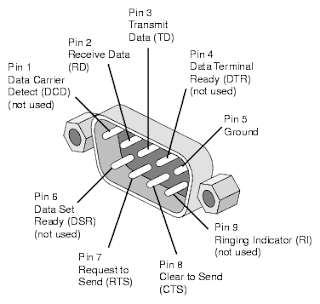
Wiki for pinouts for cables and connectors.


05 November 2007

As unbelievable as it is, after a year or more of looking around, rfidguy bought a fun little car.


That's Lori standing by my 2005 MINI Cooper S. Purchased on ebay... that's a story in itself.

Last weekend we drove it to a MINI Club event at Fontanna Village in the Smokey mountains. The event, "MINIs Slay the Sleeping Dragon" was great fun -- 11 miles, 318 turns.


Here's 37 MINIs parked at the bottom of Fontanna Dam.


Lori and Damon

30 May 2007

Now where the heck is that dBm to mW chart? I saw it laying somewhere on this $%^@# desk.

Oh, here it is.

Labels:

16 February 2007

More companies are providing Development Platforms for ZigBee. The ZigBee Alliance validates and certifies these hardware platforms and calls them "ZigBee-compliant Platforms" (ZCP).

Going forward, I see ZigBee being a great way to implement active RFID tags. ZigBee defines 3 types of devices:

  • ZC - Zigbee Coordinator: initiates network formation, the RFID interrogator (reader).
  • ZR - Zigbee Router: participates in multi-hop routing, could be used to extend RFID read range.
  • ZED - Zigbee End Device: low cost/low power, the active RFID tag.

****

Look here for list of ZigBee Chips and Modules.

Labels:

01 November 2006

Back a few months ago I wrote "RFID tags as virus carriers -- a bit of RFID FUD".

Joel on Software has a related article -- and describes this type of database exploitation as an SQL Injection Bug.
"Unfortunately it's a gigantic security hole called SQL injection.

The user, if malicious, can close the string that you opened, finish your select statement, put in a semicolon (the SQL statement separator), and then type any SQL code they want, and it will run."

In the "RFID virus" case, the user places the malicious codes on the RFID tag and relies on the RFID reader to present them to the host application unfiltered.

Joe's description is much more accurate but less headline-grabbing than: "RFID Virus capable of spreading to other tags and infecting your inventorying system".

12 October 2006

What do I do when in Germany:

o Drink beer? sure.

o Watch fusbol (soccer)? why not.

o Support ETSI Dense Reader Synchronization trial? Absolutely

ETSI Tests Show EPC Scaleable in Europe

In a final, large-scale test involving 20 full pallets of tagged cases
moving through portal reading zones, all interrogators tested worked
in sync while still observing ETSI regulations.

An RFID-focused subgroup of the European Telecommunications Standards
Institute (ETSI) conducted tests to determine the effectiveness of RF
signal-synchronization schemes designed to enable large numbers of
interrogators to function simultaneously under current ETSI
regulations. Such rules require devices using the UHF band to listen
before transmitting to ensure that a frequency channel is not already
in use by another interrogator. If a reader can not find a free
channel on which to transmit a signal, it could hamper a company's
business processes, such as moving a pallet of goods through a portal
reader...

see entire ETSI Sync article at RFID Journal